
About this site
Find out why this site exists, how we chose the four awards and how it grew out of the Dicea app.
Why this site exists
Award results are scattered. Each competition publishes its own in its own language, often without the early years. Wikipedia also covers each award separately. Here, we bring all four together from their first edition to today. You can browse by category, compare a year's results or find all the awards a game has won.
The awards
Understanding our Trophies
To give you the best guide to the board game world, we've kept only the four most influential awards on the planet.
-

Spiel des Jahres
The ultimate worldwide award for the best family game.
the worldwide benchmark (Germany)
-

As d'Or
The major French-speaking award of the Cannes festival.
the crowning of the French-speaking market (France)
-

Deutscher Spiele Preis
The benchmark award for expert and strategy games.
the connoisseurs' choice (Europe)
-

Golden Geek Awards
The award voted directly by the worldwide community of players.
the international public's favourite (USA)
Electing the Game of the Year: our ultimate crown
Every year, our algorithm names the outright winner shown at the top of the timeline. The game with the most category wins comes first. When wins are tied, the other places in the results break the tie, followed by the legendary Spiel des Jahres as referee.
A ruthlessly demanding pick
The results keep winners, runners-up and other useful places. Award badges are reserved for category winners only.
Editorial choices
Why these four awards
There are dozens of board game awards. We cover four here because they're the only ones that meet all three criteria below.
- An unbroken record since the award was created. An archive needs every year so you can follow its history.
- A real influence on the market. These awards affect print runs and which games reach shop shelves, and can help you choose what to play.
- A different way of choosing winners: a closed jury, a French-speaking professional jury, a broad professional vote, and a vote open to everyone. They don't always agree, which makes their choices interesting to compare.
Awards we don't cover here
The Kennerspiel and Kinderspiel des Jahres are not separate awards: they are categories of the Spiel des Jahres, so they appear in its results. The Diana Jones Award can recognise a person or a magazine as well as a game, so its results are harder to compare here. The International Gamers Awards mainly reach dedicated gamers. The Origins Awards have changed their categories often, making comparisons between years difficult. Finally, convention and shop awards mostly recognise games that were available on site that year.
Why the Deutscher Spiele Preis podium, and not its Top 10
The Deutscher Spiele Preis publishes a ranking of ten games based on a broad vote. We keep the top three for three reasons. The podium answers the question "who won that year?". Differences further down the ranking, such as between sixth and eighth place, depend more on variations in the vote. Finally, the other awards name one winner per category. With ten games a year, the DSP would take up much more space on the year, decade and game pages. Keeping the podium gives all four awards a more balanced place on the site.
The order they appear in
The order is consistent across the site and depends on the language you're reading. In English, we start with the Spiel des Jahres, a worldwide reference with a strong influence on the market, then the As d'Or, the major French-speaking award. The Deutscher Spiele Preis brings the perspective of dedicated gamers. The Golden Geek Awards come last, with an open vote from the BoardGameGeek community.

The Dicea app
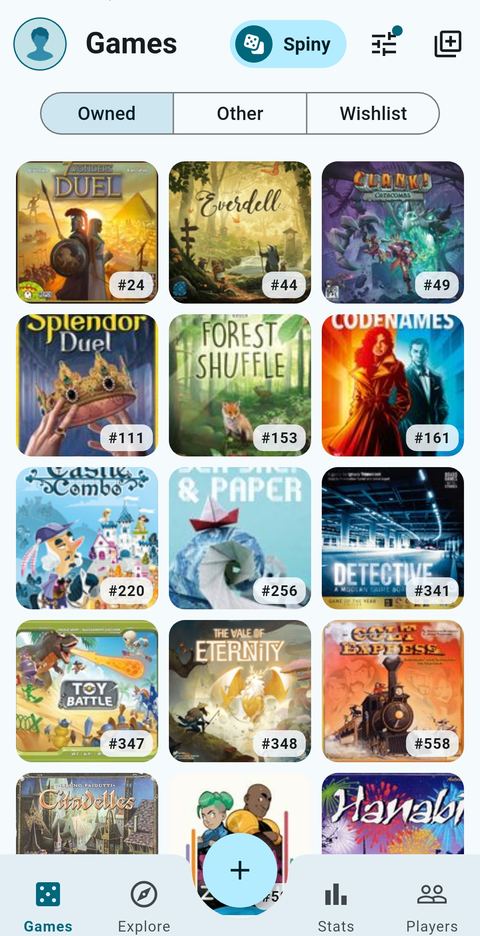
With Dicea, find the award winners in your collection and keep track of your plays.
- Free
- Works offline
- No account
- Built by one enthusiast